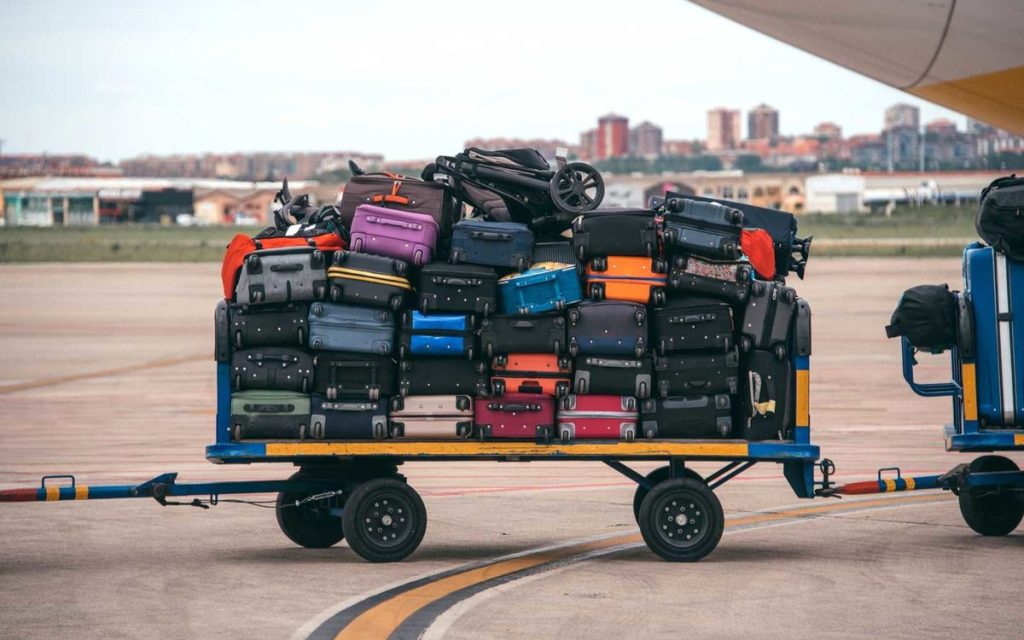
Your luggage goes through three main phases, controlled by a complex system of tilt trays and scanners known as the Baggage Handling System (BHS).
Phase 1: Identification and Security Screening
This is the fastest and most critical part of the journey.
1. The Luggage Passport (The Tag)
When you hand over your suitcase at check-in, the agent attaches a tag. This tag contains:
- A Unique Bar Code: This links the bag to your reservation, name, destination, and transfer information.
- RFID (Radio Frequency Identification): Modern airports also use this technology. It’s a small chip that allows real-time tracking of the luggage without the need for direct scanning.
2. The Belt Ride (The Conveyor)
Your suitcase disappears behind the counter and enters a vast network of conveyor belts. The bag is immediately scanned so the system can determine its destination and direct it correctly.
3. The Five-Level Security Check
Every piece of checked baggage goes through an Explosive Detection System (EDS) inspection, which usually has five levels of control:
- Level 1 (Automated X-ray): The system automatically analyzes the image and looks for suspicious densities or shapes.
- Level 2-3 (Higher Scrutiny): If the system flags the bag, it is sent for more detailed scanning. Here, human operators also review the images.
- Level 4-5 (Manual Inspection): If suspicion is serious, the baggage is diverted for manual opening (usually in the presence of security staff). If opened without your presence, you will find a notification inside.
Phase 2: Automatic Sorting and Routing
After clearing security, the real magic of logistics begins.
4. High-Speed Sorting
The baggage enters the main sorting system, which in the largest hubs can process thousands of pieces of luggage per hour.
- Tilt Trays and Diverters: The suitcase moves on carts or special belts. At intersections, the system reads the bar code and automatically activates a diverter (or “pusher”) which shoots the suitcase with millisecond precision onto the correct belt leading to its target gate or transfer point.
5. Handling Transfers
This is the riskiest point. If you have a connecting flight, the system must determine if the baggage has a chance of making the flight.
- If the layover is short (e.g., under 60 minutes), the system prioritizes transporting the suitcase to that flight.
- If a flight is delayed, the system may automatically re-route your bag or hold it in a dedicated storage area until it receives instructions to be placed on the next available flight.
Phase 3: Loading onto the Aircraft and Delivery
The suitcase reaches the final stage of its journey to the plane.
6. Preparation for Loading (Make-up Area)
Near your departure gate, the suitcase is diverted to an area known as the “make-up area.” Here, the baggage leaves the main automated system and is taken over by Ground Handlers.
7. The Journey to the Cargo Hold
The luggage is either:
- Placed manually into the aircraft’s cargo hold (especially on smaller planes).
- Loaded into ULD containers (Unit Load Devices): These are large, precisely sized containers used on bigger aircraft.
8. The “Reconciliation” Check
Before takeoff, the airport must verify that every loaded suitcase belongs to a passenger who is physically on board the aircraft (a security rule). If a passenger leaves the flight, their baggage must be unloaded.
PRO TIP: One of the main reasons for lost luggage is an old tag from a previous flight. Remove old tags to prevent scanners from misrouting your suitcase.