Barcelona is not merely the capital of Catalonia; it is the embodiment of a creative dream, where the Gothic alleys of the Middle Ages instantly merge with the fantastical, breathtaking structures of Antoni Gaudí. It is a city that exists in a constant, yet harmonious, tension: between Spanish and Catalan identity, between the siesta and the relentless bustle, and between majestic history and seaside casualness.
No other European city has undergone such a dramatic renaissance. Until 1992, Barcelona was an industrial port city that turned its back to the sea. After the Olympic Games, however, a massive transformation occurred, making it an icon of urbanism and one of the most visited metropolises in the world.
Prepare for a journey deep into the heart of Catalonia, which will guide you from the golden beaches of Barceloneta, through the labyrinth of the Gothic Quarter, up to the heavenly heights of the Sagrada Familia.
I. 🏰 The Historical Heart: Ciutat Vella (The Old City)
Barcelona’s historic center (Ciutat Vella) is a mosaic of four unique neighborhoods that tell a story spanning centuries, from its Roman founding (Barcino) to its medieval glory.
1. Barri Gòtic (The Gothic Quarter)
This is the soul of Barcelona. Barri Gòtic is a labyrinth of narrow, winding streets, often too tight for a car to pass. A walk through this quarter is a journey back in time, where a Roman wall or a medieval church is hidden around every corner.
- Cathedral of the Holy Cross and Saint Eulalia (Catedral de Barcelona): Although its facade dates from the 19th century, its core is pure Catalan Gothic. Don’t forget to visit its tranquil internal courtyard, home to 13 white geese – each symbolizing the age at which Saint Eulalia was martyred.
- Plaça Sant Jaume: The political heart of Catalonia. On opposite sides of the square stand the City Hall building (Ajuntament) and the seat of the Catalan Government (Palau de la Generalitat). It is a place of constant demonstrations, celebrations, and public life.
- Plaça Reial: One of the most picturesque squares in Barcelona, lined with palm trees, beneath whose arcades sit elegant restaurants and bars. Interestingly, the lamps in the middle of the square were one of the first public works designed by a young Antoni Gaudí.
2. El Born (Culture and Luxury)
In the Middle Ages, the El Born district was a center for maritime trade and tournaments, inhabited by wealthy merchants. Today, it is the most fashionable quarter with high-end boutiques, artisan workshops, and galleries.
- Basilica of Santa Maria del Mar: A true jewel of Gothic architecture, built in the 14th century in record time and financed by local fishermen and craftsmen. Its slender and elegant interior stands in contrast to the heavy Gothic cathedrals.
- Picasso Museum (Museu Picasso): Although Pablo Picasso was born in Malaga, he spent his formative years in Barcelona. The museum in El Born (on Carrer Montcada) contains an extensive collection of his early works, revealing his transition from classicism to innovative styles.
3. La Rambla and La Boqueria
La Rambla is the famous 1.2 -kilometer promenade separating the Barri Gòtic from the El Raval district, stretching from Plaça de Catalunya down to the port. Although undeniably touristy, it is the city’s main artery.
- Mercat de Sant Josep de la Boqueria: Barcelona’s most famous market, a kaleidoscope of colors, tastes, and smells. From fresh seafood, exotic fruit, to cured meats and specialized pincho bars—it’s a gourmet paradise and a testament to Catalan culinary abundance.
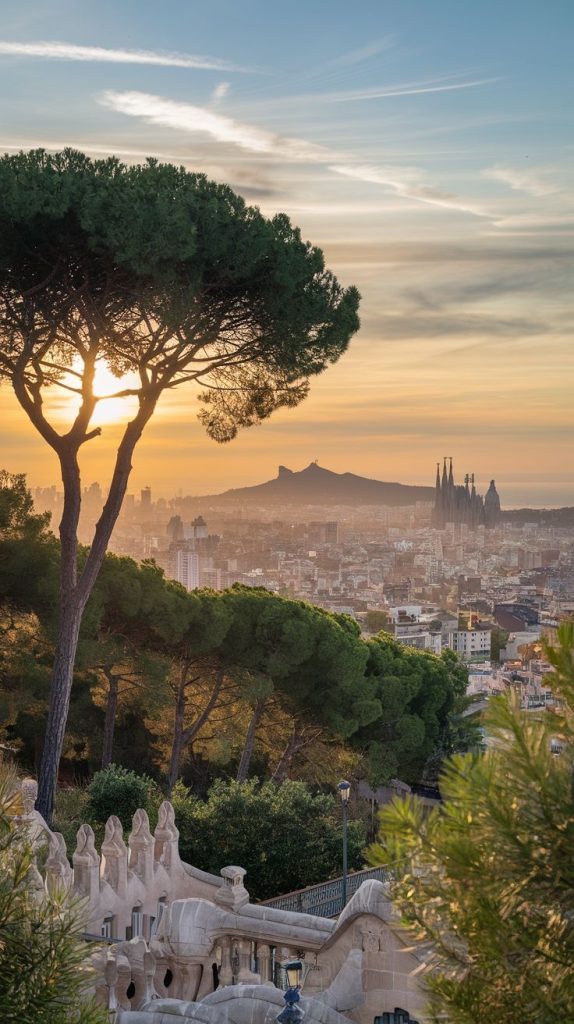
II. 🌟 Gaudí’s Legacy: Architecture as Fantasy
Barcelona is the city of Catalan Modernism, an artistic movement from the late 19th and early 20th centuries, whose dominant figure was Antoni Gaudí ( 1852 – 1926 ). His works defined the visual identity of the city, and seven of them are inscribed on the UNESCO World Heritage list.
1. Sagrada Familia (Temple Expiatori de la Sagrada Família)
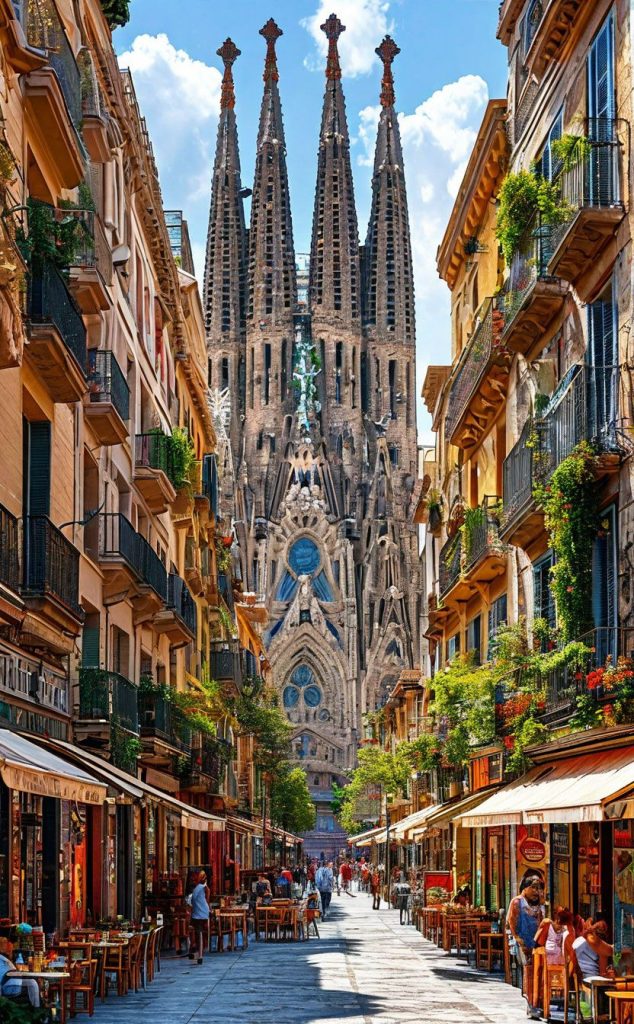
The structure that has become the symbol of Barcelona. The Sagrada Familia is the largest unfinished Catholic church in the world. Gaudí conceived it as an “architectural Bible,” where every tower and façade tells a story.
- Construction: It began in 1882. Gaudí devoted over 40 years to it, the last 15 years of his life exclusively to this project. After his death, construction continued based on his models, albeit with significant interruptions.
- Completion: The temple is scheduled to be completed in 2026 , exactly on the centenary of Gaudí’s death. Although it remains a construction site, its interior is breathtaking—columns resembling trees that branch into leaves, and light filtering through the colorful stained glass creates a magical forest effect.
2. Park Güell (The Fairytale Dream)
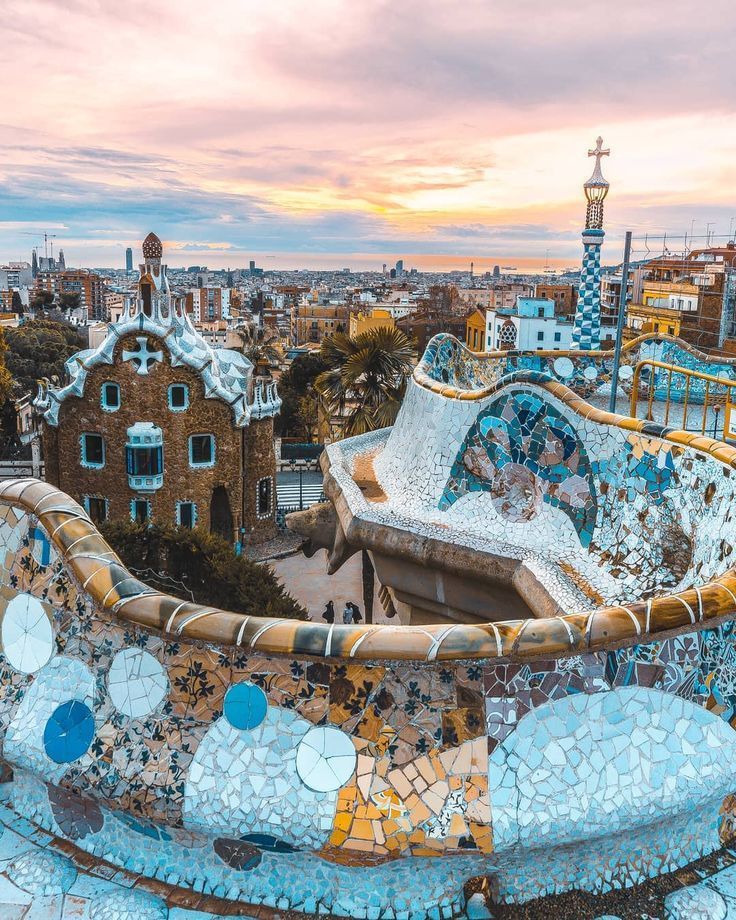
Originally intended as a luxury residential area for wealthy citizens, it eventually became a public park. Park Güell on Turó del Carmel hill is an explosion of colors, mosaics (trencadís), and organic shapes.
- Terrace and Bench: The main terrace offers a panoramic view of Barcelona and the sea. It is lined by the famous, long, undulating bench covered in colorful mosaic, ergonomically designed for seating.
- Guardhouses at the Entrance: The two iconic guardhouses at the entrance and the famous lizard sculpture (El Drac) are the most photographed spots in Barcelona. Reservations are essential in advance to visit the Monumental Zone.
3. Iconic City Houses on Passeig de Gràcia
The luxurious boulevard Passeig de Gràcia is an open-air gallery of Modernism, where Gaudí’s neighbours competed to build the most extravagant house.
- Casa Batlló: Known as the “House of Bones” or “House of the Dragon.” Its façade is inspired by ocean waves and dragon scales. The chimneys resembling animal bones and the roof, said to represent the back of the dragon slain by St. George (the patron saint of Catalonia).
- Casa Milà (La Pedrera): “The Stone Quarry.” Gaudí’s last civil work. The façade looks like a wavy, unhewn stone. The building had no straight load-bearing wall and was controversial for its radical aesthetics. The rooftop, with its fantastic chimney-warriors, offers wonderful views.
III. 🌊 Life by the Mediterranean: From Port to Beach
The 1992 Olympic Games transformed Barcelona, creating a long line of artificial beaches that changed the city’s relationship with the sea.
1. La Barceloneta
Originally a fishing district with narrow streets and low-built houses, it is now the city’s most famous beach. La Barceloneta is ideal for relaxation, tasting fresh seafood at restaurants called chiringuitos, and watching street performers. Today, you can also find the modern Port Olímpic here with its marina and nightlife.
2. Montjuïc and the Magic Fountain
Montjuïc Hill is the city’s green sanctuary, home to Olympic sports facilities, museums, and botanical gardens. It offers some of the best views of the harbor and the city.
- The Magic Fountain (Font Màgica): At the foot of Montjuïc, in front of the monumental Palau Nacional (home to the Museu Nacional d’Art de Catalunya), is the famous fountain. Especially in the evenings, it creates a spectacle of light, water, and music, although its operation is often restricted due to drought conditions.
3. Eixample (The Extension)
Eixample (Catalan for “Extension”) is the newest and largest district, created in the $19^{th}$ century according to the revolutionary plan of urban planner Ildefons Cerdà.
- Cerdà’s Plan: This area is characterized by its grid structure of streets and octagonal blocks, whose chamfered corners (chaflanes) create open space at intersections, improving visibility and ventilation. It is a textbook example of modern urbanism and home to most of Gaudí’s architectural masterpieces.
IV. 🍽️ Culinary Delights: What to Taste in Catalonia
Catalan cuisine differs from the rest of Spain, emphasizing Mar i Muntanya (Sea and Mountain)—a combination of seafood and meat.
1. Tapas, Paella, and Vermut
The basis of Barcelona dining is the communal sharing of food.
- Tapas: While tapas are a pan-Spanish phenomenon, in Barcelona, you will also frequently encounter pintxos (small snacks on a piece of bread, typical of the Basque Country but popular in trendy bars).
- Pa amb Tomàquet (Pan con Tomate): The Catalan pride. A seemingly simple dish—toasted bread rubbed with garlic, smeared with ripe tomato, drizzled with olive oil, and sprinkled with a pinch of salt. It is a side dish to everything and a gastronomic symbol of Catalonia.
- Paella: Typically served as a main course, often in the seafood restaurants in Barceloneta. Ask for Paella de Marisco (seafood paella) or Fideuà (a paella variant where rice is replaced with short pasta).
- Patatas Bravas: Fried potatoes served with a spicy sauce. Every restaurant has its own version; look for one with a creamy, smoky sauce and not industrial ketchup.
- Crema Catalana: The Catalan variant of crème brûlée, usually flavored with lemon zest and cinnamon.
- Vermut (Vermouth): An aperitif whose Sunday consumption before lunch (Fer el Vermut) is a beloved tradition, especially in smaller, authentic bars in neighborhoods like Gràcia.
2. Mercat de la Boqueria vs. Mercat de Santa Caterina
For buying fresh produce, Boqueria is a mandatory stop, but for a more local and authentic experience, visit the Mercat de Santa Caterina in El Born. Its colorful, wavy roof, designed by architects Enric Miralles and Benedetta Tagliabue, is a modern architectural work and a symbol of the revival of traditional markets.

V. ☀️ Practical Guide and Etiquette
When to Visit Barcelona?
| Season | Period | Average Temperature | Recommendation |
| Spring | April – May | 18C – 22C | PEAK SHOULDER SEASON. Ideal weather for sightseeing and trips. Minimal rain. |
| Autumn | September – October | 23C – 28C | PEAK SHOULDER SEASON. The sea is still warm, and tourists are slowly diminishing. |
| Summer | June – August | 28C – 35C | Very hot, many tourists, but ideal for swimming and nightlife. |
| Winter | December – February | 10C – 15C | Low prices, quieter city. Cool but pleasant for walking. |
Personal Advice: Avoid August, when the heat is most intense and prices are highest. May or October are the best in terms of weather and crowds.
Accommodation and Transport Tips
- Transport: The metro system is excellent, modern, and reliable. For tourists, it is worth buying the Hola Barcelona Travel Card (valid for 2, 3, 4, or 5 days) for unlimited travel on the metro, buses, trams, and trains.
- Best Neighborhoods for Staying:
- Gothic/Born: If you want to be right in the center of the action (be prepared for noise).
- Eixample: Ideal for luxury hotels, wide streets, quietness, and easy access to the transport network.
- Gràcia: For a local experience. A former village that still maintains its intimate, bohemian atmosphere with squares and local markets.
Overtourism and Respecting Local Life
Barcelona faces the challenge of overtourism, which increases rental prices and changes traditional neighborhoods. To respect local life:
- Noise: Avoid loud behavior in residential areas (Ciutat Vella and Barceloneta), especially late at night.
- Language: Although you can speak Spanish everywhere, a small attempt at Catalan (“Hola,” “Gràcies”) is appreciated and shows respect for the local culture.
- Food: Instead of frontline restaurants on La Rambla, look for bars in Poble Sec or Sant Antoni for authentic and cheaper tapas and fixed menus (menú del día).
Barcelona is a complex and tirelessly dynamic organism. It is a place that forces you to look up at Gaudí’s masterpieces and simultaneously down at the traces of ancient Rome. It is a Mediterranean city with the soul of a Northern European: always elegant, always proud, and always full of life.
Dear fellow travelers, if my articles have helped you or inspired your journeys, you can support me in a very simple way. If you book your flights, hotels, or tickets through the links below, I will receive a small commission from the sale. This costs you absolutely nothing extra (the prices remain exactly the same for you), but it truly helps me take my children on our next adventure and write the next detailed travel guide.
Here are the services I personally use on our travels and that you can rely on:
-
 Flights: I prefer to compare prices using Kiwi.com : last minute flights : https://kiwi.tpk.lv/8NQF6GkN or through the global search engine Aviasales : https://aviasales.tpk.lv/gKYbo853 .
 -
 Accommodation: 90% of our stays are booked traditionally through Booking.com : https://booking.tpk.lv/cLbuaDaA. If we are traveling to Asia, Agoda : https://agoda.tpk.lv/OwlTkUi6 often offers better prices and deals.
 -
 Experiences & Tickets: To avoid standing for hours in ticket queues for landmarks with my children, I buy them in advance via GetYourGuide : https://getyourguide.tpk.lv/V6GC2pLm or through [Viator : https://viator.tpk.lv/jKVITxSH .
 -
 Car Rental: When we need a car on our journeys, I compare rental prices through QEEQ : Diamond Membership : https://qeeq.tpk.lv/1YoVmDCm ,
 -
 Internet Abroad: To have mobile data immediately upon arrival and avoid hunting for local SIM cards, I use a digital eSIM via Airalo : https://airalo.tpk.lv/YGyayoZj .
Thank you for every single click and booking; I deeply appreciate it!